COMMODITY · RUBBER · HS 4001 · 4011
Rubber under the EUDR.
Natural rubber in primary forms plus new pneumatic tyres — while retreaded tyres left scope with the July 2026 amendments (as amended — confirm the current Annex I).
FIG 01 — YOUR OBLIGATIONS
Three facts before anything else.
SCOPE
HS 4001 · 4011
Rubber products under the listed HS codes — plus listed derivatives. Representative table below; the current Annex I is the boundary.
GEOLOCATION
POINT ≤4 HA · POLYGON >4 HA
Tapping plots are small (points); estates and concessions map as polygons.
DEADLINE
30 DEC 2026 / 30 JUN 2027¹
Tyre and rubber-goods importers: micro/small prepare for 30 Jun 2027, medium/large for 30 Dec 2026, per Regulation (EU) 2025/2650.
¹ Regulation (EU) 2025/2650.
FIG 02 — WHAT'S IN SCOPE
The Annex decides, not the label.
Natural rubber and listed products — primary-form rubber, compounds, and new pneumatic tyres — have been in scope since Regulation (EU) 2023/1115 as amended.
The July 2026 amendments removed retreaded tyres from the list (as amended — confirm the current Annex I). Synthetic rubber (4002) was never listed.
| HS CODE | PRODUCT NOTE |
|---|---|
| 4001 | Natural rubber, balata and similar gums, primary forms |
| 4003 | Reclaimed rubber, primary forms or plates |
| 4005 | Rubber compounds, primary forms |
| 4011 | New pneumatic tyres (motor cars, buses, motorcycles…) |
| 4012 | Retreaded tyres — removed from scope, July 2026 amendments (as amended) |
REPRESENTATIVE CODES ONLY — ALWAYS CONFIRM AGAINST THE CURRENT ANNEX I OF REGULATION (EU) 2023/1115 AS AMENDED.
FIG 03 — GEOLOCATION RULES
One threshold, two formats.
≤ 0 ha
POINT ALLOWED
A single WGS84 coordinate at six decimal places locates plots of 4 ha or less.
> 0 ha
POLYGON REQUIRED
Plots above 4 ha need a closed vertex ring tracing the full boundary.
RUBBERTapping plots are small (points); estates and concessions map as polygons.
FIG 04 — SUPPLY-CHAIN REALITY
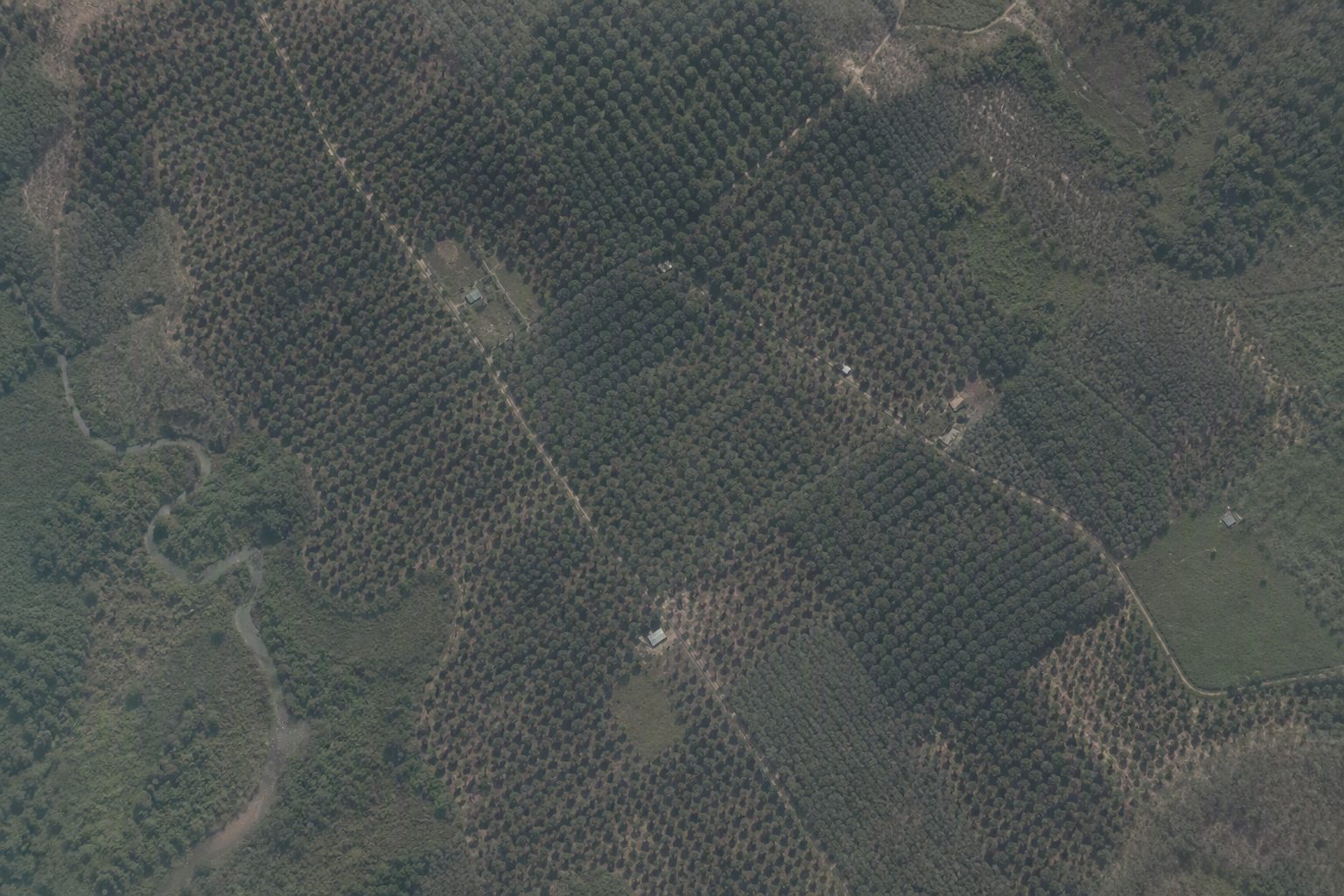
Natural rubber starts as latex in cups on trees tapped daily across millions of smallholdings in Thailand, Indonesia and Côte d’Ivoire. Typical holdings sit under 4 ha.
Between the tapper and the processor stand dealers and village collectors who aggregate wet latex and cup lump within hours. Each hand-off blends origins — and each one is a place where plot identity gets lost unless it is recorded.
Processors and tyre makers have long mapped their tier-1 suppliers; the EUDR pushes that mapping to the tapping plots. Points are the realistic format for smallholdings; estates and plantation concessions use polygons.
Since retreaded tyres left the list (July 2026 amendments, as amended), scope centers on natural rubber in primary forms and new pneumatic tyres — confirm the current Annex I for your exact codes.
“Natural rubber changes hands three times before it’s a bale — each hop is a geolocation you still have to recover.”
KEY RISK — RUBBER
Dealer layers are rubber’s blind spot: origin data rarely survives past the first aggregator. Collect plot coordinates at the point of first purchase.
FIG 05 — SCREEN A RUBBER PLOT
See it run on a real-shaped plot.
The scope-checker validates the geometry, screens it against open satellite datasets, and returns an indicative signal summary — one plot, free, no card.
Screen your rubber plot — freeSAMPLE PLOT
THAILAND · SOUTHERN TAPPING PLOT · POINT
6.9330, 100.4140
DATASET: WHISP · HANSEN GFC v1.11 · GLAD ALERTS
Indicative screening for decision-support only — not a compliance determination, certification, or legal advice. Due-diligence obligations remain with the operator (EUDR Art. 10). · DEMO RESULT — configure the Whisp API in admin settings for live screening.
FIG 06 — QUESTIONS
Asked about rubber.
RUBBER · SCOPE-CHECKER
Screen your rubber plots.
Free, one plot, indicative screening in about two minutes — prefilled for this commodity.
Run the scope-checker — freeIndicative screening for decision-support only — not a compliance determination.